06/03/26
Note: This essay will contain extensive spoilers for Seasons 4 and 5 of Stranger Things, and minor spoilers for the rest of the show too. It also contains minor spoilers for WandaVision and Labyrinth. I’ve tried to make it comprehensible for people who haven’t seen Stranger Things, without recapping too much.
Season 4 of Stranger Things had the tagline “Every ending has a beginning.” And Season 4 certainly was the beginning of the end, in more ways than one. Season 4 brought with it a new, borderline omniscient antagonist, resurrected Hopper from the dead, began the unrequited love storyline between Will and Mike in earnest, added two more side characters to the show’s bloated roster, and ended on a distinctly apocalyptic tone. Following its conclusion, Netflix also dropped two major tie-in pieces of media: A radio station (WSQK The Squawk), and a prequel stage play called The First Shadow, which delves deeper into the backstory of the main villain of the show. This was all intended to lead into Stranger Things Season 5, which would be the final season.
That’s a lot of threads for Stranger Things 5 to build upon and wrap up satisfyingly. So, you can imagine people’s surprise when the season decided to devote a huge chunk of its runtime to 12 entirely new child characters and the logistics of a new fake dream dimension, all without even remotely trying to tie this subplot into the themes or emotional core of the show at all. The “Camazotz” storyline simultaneously takes up way too much time and energy that could be better allocated to the main characters that we actually care about, while also not receiving enough time or energy for the audience to actually become invested in the new characters. It shouldn’t be possible, and yet it exists. It is the exotic matter of storytelling.
There isn’t a universe out there where you could slot this subplot into an eight episode final season of a television show and have it feel satisfying. But I do think the Camazotz storyline has a lot of compelling ideas that the show completely fails to capitalise upon. Picking up on any one of these could have at least justified its existence.
Optional Plot Summary
For anybody who has not seen Season 5 of Stranger Things, or those who would like a refresher, here is the approximate totality of just the Camazots storyline:
Holly Wheeler is the youngest child of Ted and Karen Wheeler. She is approximately ten years old and loves the book A Wrinkle in Time. Her parents, Karen and Ted, have a strained marriage owed primarily to Ted’s disinterest in his kids. One day at school, she is contacted by a magical man called Mr Whatsit, first name Henry, who informs Holly that the world is being invaded by monsters and he needs her help to save it and also her parents’ credit card information. None of the adults are able to see Mr Whatsit, so they believe he's just an imaginary friend. This still causes concern as Holly should have aged out of imaginary friends by now. One night, after hearing her parents argue, Holly is attacked by a monster (a demogorgon, which is an interdimensional skinny tall thing that eats people). Her mother and father try to fight it off but are both severely wounded and Holly is kidnapped.
She wakes up in Camazotz, the magical dream-like world where Henry lives. She is welcomed into Henry’s home, where he claims he will soon be bringing all of her friends and family. Henry has to temporarily leave her alone in the house, but he warns her to never go into the woods because that’s where the monsters live. Holly soon receives a letter, allegedly from Henry, telling her to go into the woods. While there, she runs into the real author of the letter, Max Mayfield. Max is part of the main cast of Stranger Things. She fell into a coma at the end of the last season after being murdered by Vecna (the name that the main cast has given Henry). Max explains that the world they are in is actually a maze inside of Henry’s mind made up of his memories. And that Henry is not a whimsical, magical man, but a demented, psychic serial killer. Max is living in a cave which is the one memory that Henry is too afraid to enter.
In the real world, the main cast of characters have figured out that Vecna kidnapped Holly, but they can’t find her anywhere. They know that Vecna plans on kidnapping more kids (12 kids in total) and so they try to pre-emptively rescue them. They start with Derek Turnbow, the school bully, and inform him of the truth about Mr Whatsit. He then tries to help them rescue the rest of the kids, but ultimately the plan is thwarted by Vecna.
Holly goes back to the house where Mr Whatsit has brought the rest of the kids. He tells the kids that he is planning on saving the world by merging Earth with the Abyss, an empty CGI desert dimension that he really likes (for some reason). All the kids are on board with this plan except for Holly and Derek. Holly and Max try to stage a distraction using Derek so they can all escape, but Derek is captured by Vecna and he gives chase to the pair. Eventually, Holly discovers another traumatic memory for Henry in a mine-shaft, which also allows her and Max to escape back to the real world. Max wakes from her coma in the real world and Holly wakes up in the Abyss, where she is promptly re-captured by Vecna.
After one last escape attempt, Holly is knocked unconscious by her friends. She wakes up in the dining room as part of a ritual where Henry begins to merge the dimensions using the collective energy of the kids' brains.
The kids are ultimately rescued by Eleven and Kali, two of Henry’s psychic siblings, who reveal Henry’s true nature. Max and Holly lead the kids away from the house into the cave, but Henry eventually catches up to them because Eleven and Kali are terrible at killing people. Henry successfully enters the cave and ultimately the mine-shaft, but is physically wounded by Holly, allowing the kids to escape.
The rest of the Stranger Things cast descend upon the Abyss and get into a truly awful boss fight with a giant CGI spider. Inside of the spider, they chop Vecna’s head off and save the kids.
Then Eleven kills herself in a big explosion that destroys the wormhole connecting the Abyss to the real world. Or maybe she didn’t kill herself and it was all an illusion and she survived and now she’s living in Iceland. Who’s to say?
Chapter One: Too Many Characters, Too Few Fucks Left to Give
It is asinine that the final season of Stranger Things would decide to introduce 12 new characters. But it is made even worse by the fact that none of these new characters have any emotional impact on the audience. The Camazotz plot only features three characters that the show tries to make you care about: Holly, Henry and Max (Four if you include Derek, who will be discussed later). The rest of the subplot characters are functionally set-dressing. Most of them aren’t even named and only two of them have unique dialogue and a hint of personality. As a group, they’re just visual noise. You could replace them with wax sculptures of kids and it would feel exactly the same.
As for the characters that actually matter, Max has already completed her character arc in the previous season, so there's little room for growth. Theoretically, the audience could be worried that Max won’t make it out of Camazotz alive. But, not only does Stranger Things hate to kill off characters (I’m looking at you, Murray), she’s already had a fake-out death in the last season. Fool me once, etc.
Any emotional depth to Henry has been locked away in paid DLC: the Stranger Things prequel stage play, The First Shadow, which did not have a pro-shoot until long after Season 5 ended (At the time of writing this, the pro-shoot still has not been released). Fans of Stranger Things who couldn’t drop hundreds of pounds to see the stage play in person, or sit through a mediocre bootleg, are left knowing almost nothing about his true backstory or interiority. The TV show pays lip service to a Henry redemption arc midway through the cgi-slopfest finale, but he ultimately chooses to remain the one-note villain that he has been for the entire season. His one scene of emotional complexity, when he relives the traumatic memory in the mine-shaft, feels like spin-off bait more than anything substantial.
That leaves us with Holly. While Holly has appeared as a background character in previous seasons of Stranger Things, she was a literal toddler and therefore didn’t leave much of an impact on the narrative or the audience. In fact, she had to be aged up just for the Camazotz storyline to make sense. Therefore, she is essentially a new addition to Season 5, and a pretty major one. She has more screentime than Will, one of the main characters of the show, in a season where Will actually gets to do things for once. It is a huge ask to expect the audience to care about such a giant new addition to the cast in the final season of a TV show, especially a TV show with as many characters as Stranger Things. Furthermore, any tension is lost from this new addition because, bluntly, we know she isn’t going to die. She's ten years old, and while Stranger Things is not above killing children, the only kids that young who have died so far were basically unnamed (RIP, Ten, Nine, etc.). Plus, Holly staying alive is baked into the narrative; Vecna can’t kill her because he’s planning on using her as a vessel for the Mind Flayer, like Will was in Season 2. But unlike Will, Holly won’t be returning in future seasons for further emotional development or repercussions.
It’s also hard to give a shit about Holly because, frankly, nobody else gives a shit about Holly. Even though Holly is the younger sister of Mike and Nancy, neither character ever shows a particular urgency about rescuing her. Every now and then Nancy will throw out a line about how Holly is her sister, and they don’t know where she is, and she’s worried, but it’s all so hollow. It’s like the Duffer Bros are reminding themselves and the audience who Holly even is. Mike is emotionally wooden in all matters outside of El, so he contributes basically nothing. Most egregiously, Mike is so checked out of Holly’s life that he doesn’t pick up on the neon red flag that is Mr Whatsit until after Holly has been kidnapped. And he seems to feel no culpability in her capture.
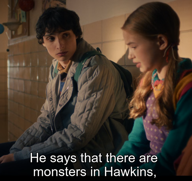
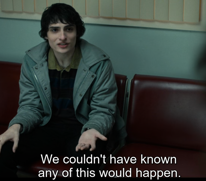
Who could have seen this coming?
The episode where Holly is taken is called ‘The Vanishing of Holly Wheeler’, a clear parallel to the first episode of the show, ‘The Vanishing of Will Byers’, but her kidnapping is not treated with any of the seriousness that Will’s was. Joyce and Jonathan (Will’s mother and brother respectively) both went completely bonkers at Will’s disappearance, in their own ways. It was the entire emotional hook and plot of Season 1 of the show. Direct parallels were inevitably setting the show up for failure because there simply isn’t enough time to focus on Holly’s disappearance, not when there’s also an end-of-the-world narrative to grapple with.
In this way, Camazots is fundamentally incompatible with the final season of Stranger Things. It's a woefully uneconomical usage of time when there are a billion trillion other characters and storylines who are starving for attention.
Chapter 2: The Vanishing of Tension
Even with characters that are unable to be killed, there are still opportunities for suspense that the show completely tramples all over. In fact, the Camazotz storyline seemingly avoids tension at every turn. While watching the season for the first time, I kept anticipating certain scenes and interactions that simply never came. It started to feel like the show was making fun of me for actually expecting a horror story to be scary.
In Episode 3, Holly takes Henry’s Spy-Scope as she heads into the woods for the first time. When she encounters Max, she drops it in terror and runs. There are two lingering shots that show the spy-glass sitting abandoned outside the cave (this is actually a very subtle reference to The First Shadow, but the show is, and should be, written under the assumption that the audience have not seen the play). She also takes a pretty significant tumble and gets a big scuff mark on her knee, which is explicitly shown up-close in Episode 4. After learning the truth about Camazotz, Holly is told she needs to return to the house and pretend like she never left. Any audience member who’s paying attention will notice that there’s now two pretty big tells that Holly has left the home: the absence of the spyglass and the injury on her leg. Both of these things are easy for Holly to play dumb or lie about, but it’s still a possible future hiccup.
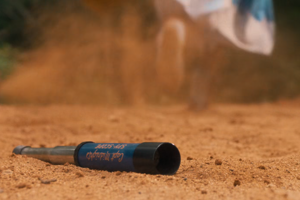
You might think this is foreshadowing something, but you would be wrong.
But no. Mr Whatsit never notices either of these things. And this is a recurrent issue in the subplot: Mr Whatsit is seemingly the most ignorant and unobservant villain possible. As the Duffer Bros have realised, creating a borderline omniscient villain is a really easy way to write yourself into a corner. It seems like the only way the writers can figure out a way for the kids to outsmart him is to make him stupid as fuck.
In Episode 5, Holly is told by Mr Whatsit that he won’t be leaving the kids alone in the house anymore. This will obviously make it hard for Holly to talk to Max, which is her ticket out of Camazotz. So, how does Holly manage to get into contact with Max? She literally just waits for the rest of the kids to watch TV and then she walks out the front door. It’s as easy as that.
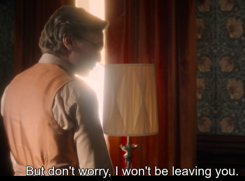
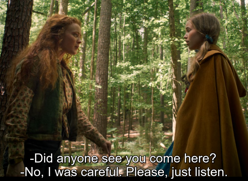
I wonder how Holly's gonna get out of this one! ...Oh.
Before Derek can be kidnapped by Vecna, he’s moved to a second location by Will and the gang. Both Derek (and Will) have a psychic link with Vecna, so Vecna is able to track down this second location by looking through Derek’s eyes. If Vecna was capable of basic inference, he would know that there’s a high chance that Will and the gang have explained who Vecna is to Derek. It’s not guaranteed, but it’s a possibility. Therefore, you would expect a higher level of scrutiny of Derek from Henry. Henry even promises Holly that he will have a word with Derek to get him to behave, prior to Derek’s kidnapping. But that never happens. And Derek is also able to just leave the house whenever he wants (barring one exception when Henry is outright baited into following him).
There’s a frustrating scene in Episode 6 where Henry chases Max and Holly to the cave entrance. He starts trying to gaslight Holly into believing that Max is really the monster, and that she’s been tricking Holly this whole time. But obviously this doesn’t work because moments prior to this, Henry turned into a beef jerky man and tried to choke Max to death directly in front of Holly. This scene isn’t bad out of context, but wouldn’t it have a greater impact for this conversation to happen before Holly sees Vecna’s true form? As it stands, it just makes Henry seem bad at manipulating people.
I feel as though the show tries to make this lackadaisical energy a deliberate character flaw of Henry. Eleven has a line in the finale about Henry underestimating the kids, so maybe that’s why he barely keeps an eye on them. But one, the only kids he underestimated are Derek and Holly, the rest are conformist as fuck. And two, that doesn’t make for an engaging storyline! A prison break isn’t satisfying to watch when the prison guards don’t do anything to prevent the prisoners from escaping.
In one of many frustrating moments in the finale, the kids run to the cave and Holly lags behind. Henry manages to grab her leg with his gross nasty tentacle arm, but Derek easily pulls her out of Henry’s grasp. Henry’s strength is clearly nerfed in favour of the kids getting out unharmed. You’re telling me he can’t pull harder than Derek Turnbow? Or he’s above breaking Holly’s leg? The sum total of scary things he does to Holly and Derek is to occasionally threaten to kill their friends and family. No harm is done to the kids. But why not?
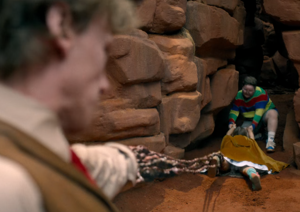
Are you stronger than a 5th grader?
It’s because putting any obstacles in the way of the plot as it needs to happen would require spending more time that we do not have. A kid with a broken leg runs slower than a kid with an un-broken leg, and we need these kids moving as fast as possible so we can get to the giant CGI spider bossfight that we blew our budget on. The script is just pulling punches to keep the plot moving at a crazy fast pace because we needed to wrap this show up yesterday.
At the same time, a number of scenes in this series also involve characters standing around yapping at each other in situations where they should probably be hauling ass. While Derek distracts Henry, Max and Holly casually waltz through the woods. Before leaving Camazotz, Max and Holly stop to have a lengthy conversation knowing full well that Henry could catch up to them at any moment, or that Max could even die in the real world. The level of intensity that the characters exhibit is seemingly picked at random at the start of the scene.
The only successfully tense moments in the entire subplot are right near the end, when Holly attempts to sway her friends and they don’t listen to her, and then the subsequent ritual scene. They’re good moments but it’s too little too late.
Chapter Three: What Even is a Girl?
Stranger Things is built off the backs of 80s nostalgia. Specifically, things that the Duffer Bros really liked when they were kids. A majority of the inspirations that Stranger Things draws from were created by men with primarily boys in mind. It’s a sci-fi horror series, and 80s sci-fi was not really marketed towards little girls.
What makes the Camazots storyline stand out is that it is actually drawing upon more feminine points of nostalgia. The piece of media that the subplot directly references the most is A Wrinkle in Time, a sci-fi story written by a female author to fill the void of sci-fi books written for girls. It is notable for its strong, complex female protagonist; Meg is nerdy, defiant of authority figures, and quick to anger, at a time when that was absolutely not the norm for female characters.
Henry’s home in Camazotz has a whimsical softness to it that is very different to the show's usual aesthetic. Everything is bright and drenched in cozy, golden light. Holly herself dresses in a puffy blue dress, reminiscent of Alice in Wonderland (which also appears as a poster in the house), and a brown cape, reminiscent of Little Red Riding Hood. Even the constant references to the dangers of “the woods” is a clear fairytale parallel. When left alone in the home, Holly fills her time with a musical montage set to Tiffany’s I Think We're Alone Now, playing from a pink stereo. During this montage, she does all the stereotypical things a little girl would do, like trying on a bunch of pretty dresses and baking a cake.
Narratively, whether deliberate or not, Holly’s story is evocative of my personal favourite 80s girly film, Labyrinth. Labyrinth tells the story of a girl so obsessed with fiction that she wills her favourite story into reality. And when her baby brother is spirited away by the Goblin King, played by David Bowie in incredibly tight trousers, she has to venture through the labyrinth to save him. At the end of the film, she confronts the Goblin King and is left with a choice: She can banish him and return to the real world, boring and tedious, or allow him to enslave her and live forever in a fantasy world.
In a similar way, we see Holly, a young, bookish girl who meets a magical man seemingly straight out of the pages of her favourite book. She's whisked away by him to a dream world where she can be the heroine of a fantasy story, and all it costs is her absolute trust and devotion to him. All it takes for Holly to save the world, according to Mr Whatsit, is to stay in the home and not cause any problems.
From this point, it seems, the story should write itself. Holly, being a little girl from a broken home, so used to retreating into fiction, feels immediately at home in the fantasy world. Having an absentee father makes her easily drawn to Henry, this handsome, soft-spoken, attentive older man. When she's confronted with the reality of the situation by Max, she's torn. Because believing Max and going home would mean going back to painful, normal reality, where she isn't special, and her home life sucks. Maybe she feels gullible and naive for believing in Mr Whatsit, and the shame that comes with that. But she chooses to fight against Henry because she actually is special. She's not like the other sheep kids in Henry’s little cult; Like Meg from A Wrinkle in Time, she's non-conformist and brave, and capable of doing the right thing even when it's scary.
But weirdly, that's not the story that we get. Instead, Holly is incredibly quick to believe Max. She seemingly feels no internal quandary in defying Henry, just fear at the situation she's in. She doesn't massively resent her friends for not believing her, or even for physically assaulting her when she tried to escape. Holly doesn't dread returning to her parents’ tattered marriage, instead she merely feels guilt in not being able to physically protect them. Her narrative becomes one about becoming brave enough to stab a monster, but that's not a meaningful piece of character development for a ten year old girl. It's not emotionally resonant to see her become brave enough to commit acts of physical violence on extra-dimensional beings because that's not something human beings are typically expected to do, let alone children.
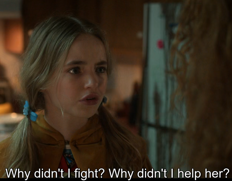
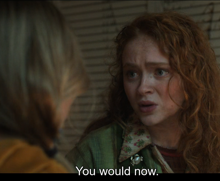
What the fuck, Max.
This shouldn’t be a story about Holly learning to overcome a reasonable fear of scary monsters. It should be a story about Holly learning to advocate for herself, even against authority figures, and to stand up for what’s right when nobody else believes her. Those are meaningful developments for a child character to undergo.
There's something frustratingly interesting too in the way that Stranger Things genderbends Mrs Whatsit into Mr Whatsit. Mrs Whatsit in A Wrinkle in Time is one of a trio of immortal women who guide the protagonists of the book. In Stranger Things, Mr Whatsit is a controlling, restrictive, older man who tells Holly what she can and can't do under the guise of protecting her. All of this happens in a home that is literally a snapshot of the 1950s. Holly’s rebellion of Mr Whatsit could be seen as a rejection of patriarchal control and an easy allegory for her feminist awakening . And the cherry on top is that this was all possible through Max, the true Mrs Whatsit of Holly’s story: an older girl who passes on wisdom to the next generation. But almost certainly none of that feminist reading is intentional.
Instead, it feels as though the Duffer Bros are fundamentally unable or uninterested in tapping into more girly interests and perspectives. They do not care to understand Holly as a person, and how her gender impacts her. She is a half-baked plot point with an absurd screentime-to-depth ratio.
Perhaps, at its most cynical, she is simply a marketing gimmick to get little girls to like Stranger Things. Or set up for the cliche “passing of the torch to the younger generation” scene in the epilogue. But why go through all that effort? Why bake the plot halfway when you could just do literally any other storyline? It's like painting the Mona Lisa and using it as a welcome mat.
If you just want a young female character for pure marketing purposes, Erica is already there and way more entertaining (But maybe they thought a blonde girl would sell better with the masses…)
Chapter Four: The Mechanisms of a Child Cult (Or: Who Invited Derek?)
I’ve already mentioned that the mass of children introduced in this plot line are basically just cardboard cutouts in the shape of people. This isn’t aided by Holly’s borderline nonexistent relationship to these kids. Holly quickly latches onto Max with apparently no concern for the safety of her previous friends. When Henry confronts the pair after catching Derek, neither party brings up the rest of the children in the house, and the danger that they’re in. Or even Derek, the kid who Max and Holly used as bait and who is now conspicuously absent. One of the kids in the house has been Holly’s best friend since Kindergarten! Holly has a crush on one of the other kids! And yet she never shows any real concern for them.
But there is an interesting hint of a concept within this group which, in typical Camazotz fashion, is not examined enough: These children are in a doomsday cult! Henry has formed an A Wrinkle in Time-themed religion, and placed himself as the figurehead of it, and the children within it occasionally spout doctrine to each other with full religious conviction. That is hilarious and weird and wonderful. There’s an amazing, corny scene where they all spontaneously begin to chant “Back to the light”, as they endeavor to re-convert Holly to the cause. It’s truly marvelous. It’s like Mr Roger’s Children of the Corn.
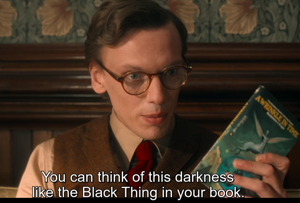
Have you heard the good word?
Initially, I believed that this cult framing was a brief, in-universe invention by Derek. Prior to Episode 4, the relationship between Mr Whatsit and these kids appears to be a standard imaginary friend situation. But then in that episode, we see Derek lead a religious meditation session with the kids who Henry will ultimately kidnap. Derek is aware of Vecna at this point, and also a massive dickhead, so this scene at the time felt like simply a way for Derek to exert power over his peers and kinda take the piss out of them. But as we see more of Henry’s interactions with these kids, it becomes clear that this is actually the true nature of their relationship. The kids are encouraged to read A Wrinkle in Time like it’s the Bible, they conceptualise the situation they’re in using vocabulary from the book, and they are hostile to people who break the rules or contradict the teaching.
This comes to a head in Episode 5 where the kids descend upon Holly in Alice’s bedroom to collectively try to gaslight her into trusting Mr Whatsit again. While most of the kids are seemingly concerned about Holly, one of the kids openly calls her stupid for not believing. This kid, at least, views his role as a true believer as putting him in a position of superiority over the non-believers. This framing is reinforced by Henry, who refers to the kids he has chosen to save as uniquely “special”.
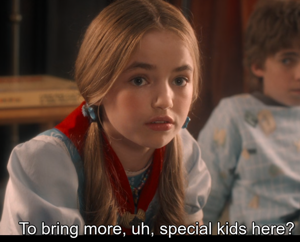
Holly also uses the same in-group language.
Eventually, Holly turns to Derek, a fellow non-believer, for backup. But he, terrified of Mr Whatsit, decides to gaslight her too. He conforms to the whims of the larger group for his own safety. This makes Holly snap and she attacks the group. The kids waste no time in escalating the violence in return. Her best friend, Mary, runs behind Holly and begins to choke her using her necklace. The necklace snaps and Holly falls down the stairs. She is knocked unconscious with a visible, bleeding wound on her head. It’s the most violence that any child undergoes in this season.
Holly’s necklace features a Dungeons & Dragons character which has been shown to give Holly hope and courage throughout the subplot. I haven’t mentioned it until now because I think it’s quite stupid. Holly’s bravery storyline, as presented in the show, is not particularly compelling, and this is primarily a symbol of that storyline.
However, the previous season of Stranger Things tackled the satanic panic as it related to Dungeons & Dragons. In that season, the Hellfire Club, a Dungeons and Dragons group, was scapegoated for Vecna’s actions. This was made easy in part due to pre-existing societal stigmas, re-enforced by Christianity, against subcultures and outcasts. This anti-D&D (or at least anti-Hellfire) sentiment persists in Season 5, with Dustin being assaulted by members of the basketball team for his continued allegiance to the club. Here in the Camazotz storyline, we again see religious fervour wielded against an innocent, non-dominant culture. The moments where Holly turns to this figure for inspiration are typically moments where she contemplates defying Henry. This is a symbol that brings Holly great comfort, but it is a false idol from the outside world and not congruous with the status-quo religion within the house.
Therefore, the cult’s social enforcement of their beliefs through ridicule, shame, and physical punishment is not only a great opportunity for emotional development for Holly and Derek, but also societal analysis. At the end of season, Dustin gives a graduation speech about cliques and conformity and how everyone comes together in the face of disaster, but if anything the cult actually shows the opposite. In fact, most of the season shows the opposite; Dustin never makes peace with the jocks. Derek’s kowtowing shows the way that people can be forcefully assimilated into the status quo through peer pressure and fear.
Derek’s role in the narrative is a little ill-defined. He’s written deliberately to be completely insufferable, but he doesn’t really go on much of a clear arc with his personality. Rather he flip-flops between two distinct characters: Dipshit Derek and Delightful Derek. When we first meet him, he is Dipshit Derek. He is callous towards others and frankly deeply annoying. For context, Dipshit Derek is an in-universe nickname that basically everybody who meets him uses. Nobody likes this kid, and Derek either likes it that way, or he’s trapped in a vicious cycle of retaliation. He is quickly persuaded to go undercover as Delightful Derek in order to rescue his friends. As I’ve alluded to previously, this misadventure doesn’t read as an earnest piece of character development for Derek, but rather a farce. His behaviour as Delightful Derek is too big a swing in the opposite direction for it to read as anything other than mockery. When in Camazotz, he is persuaded to become Dipshit Derek again in order to distract Henry. So again, we see him flip-flop. We are continuously presented with these two personas as exactly that: personas. It still feels as though his true self lies closer to Dipshit Derek.
None of this is bad inherently. Stories need conflict and Camazotz is sorely lacking in it. Derek should have been a disrupting, or duplicitous force within the house. And his best moments are when he’s allowed to fulfill that role. But there just isn’t enough time to spare to devote to Derek’s interiority. Therefore, Derek feels like he is whatever he needs to be in the moment to progress the plot.
In some regards, Derek is not a character, he is a comedic prop. Stranger Things has a lot of characters like that; Argyle and Erica are the first that come to mind. He’s most like Erica, as both are smart-ass younger kids who annoy the main cast with their abrasive personality. The problem with that comparison is that Erica was written to be charming. Erica is intelligent and genuinely witty. She also does care about people, even if she initially seems to prioritise herself. She’s a nerd at heart, and in the context of Stranger Things, “nerd” typically equals “good person”. Meanwhile, Derek’s assholishness comes from a place of extreme privilege. His family is loaded and his parents are conservative and that’s why he is the way he is. Just because he’s a nerd doesn’t mean he’s a good person. There’s no secret empathy hidden deep within because he’s been raised in an environment that does not require it of him.
Derek’s arc should therefore be something similar to Steve’s. Steve begins Stranger Things as a similar bully archetype, but as the show progresses we see that Steve’s assholishness is primarily a product of peer pressure, reinforced by his shitty friends and his fear of being seen as uncool. By the end of the show, Steve has fully abandoned all sense of cool in favour of becoming a defender of the uncool. It’s this arc, alongside Joe Keery’s charismatic performance, that has made Steve one of the most beloved characters in the show.
If we interpret all events prior to Derek being captured by Henry in the woods as farcical on behalf of Derek (There was never a Delightful Derek, he was simply playing the role for self-serving reasons), then the thing that makes Derek ultimately develop empathy is when his family’s lives are threatened. Derek’s pseudo-arc seems to begin here. But when Derek’s bubble of privilege bursts, it only makes him want to suck up to the status quo even further.
In ultimately siding with the cult at the climax of the subplot, Derek actually eschews Steve’s arc in a way that could be very interesting. Not everybody is Steve; some people will back down in fear. It also shows that Derek is prioritising defending himself and his family, not Holly or the world at large. Which is good, by the way, from a conflict and characterisation perspective. Derek doesn’t need to learn to be self-sacrificing. Not to mention, he's literally a child.
And yet, following the ritual, he spontaneously becomes self-sacrificing. As they run from Henry in the finale, Derek has a little “Go on without me! Save yourself!” moment. But what’s changed for Derek between his betrayal of Holly and this moment? The only notable difference is that the group have now turned against Henry. So again, it feels like all we see from Derek is his propensity to behave in accordance to the whims of the dominant group. But it feels like we’re supposed to view Derek as having gone on a more selfless journey of development. His true form is now Delightful Derek!
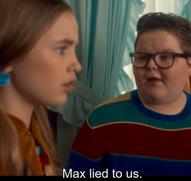
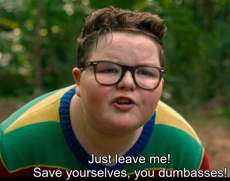
What changed? Is he just defeatist?
In fact, we’re meant to view all of these characters in the best possible light at the end of the show. Unfortunately, like most things in Season 5, there aren't any repercussions for the child cult. This is a microcosm of a larger problem with consequences in Season 5, which is to say that there isn’t any.
There’s two characters in the child cult who barely get more attention than the others: Mary and Thomas. Mary is Holly’s best friend. Thomas is an asshole.
Mr Whatsit initially plays favouritism with Holly, telling her that he’s glad he brought her to the house first because she’s “the brightest of them all.” We can guess at his real motivations for picking her first. Possibly he believes that Holly is the most easily manipulated of the kids and she can serve as an example of good behaviour. Or it’s more malicious; he picked Holly because she’s Mike and Nancy’s sister and he wants to punish them for defeating him last season (this is Nancy’s initial interpretation). Or it’s a bit of both. But regardless, being brought into the home first would obviously grant her some level of prestige.
Upon Holly’s betrayal of the group, Mary is the one who steps into Holly’s role as the de-facto leader. She’s the one who rallies the kids into bringing Holly “back into the light.” Thomas is the inciting force in the physical assault of Holly, he even calls her a “bitch” in the process. As I mentioned earlier, he clearly relishes in the power that the cult gives him.
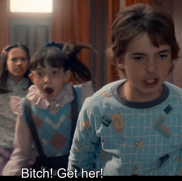
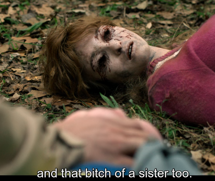
I wonder where Thomas learned that language from...
Mary is the one who chokes Holly and knocks her down the stairs. Noticeably, during the ritual, Thomas and Mary are seated on either side of Henry. While Mr Whatsit might chastise Thomas for insulting Holly, and beg the kids not to turn on each other, his actions say something different. Thomas and Mary are actually rewarded for their mistreatment of Holly.
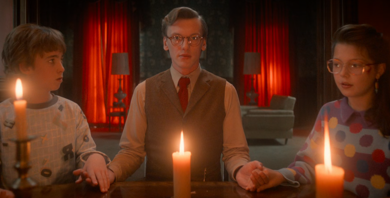
The little bastards in question.
But in the final scene of the entire show, Holly and Mary and Derek are all playing Dungeons and Dragons together. Everything is forgiven, without any acknowledgement of their role in Holly’s mistreatment. It’s like none of it ever happened. Derek’s also back to being an asshole in this scene but I guess we’re meant to find it endearing now.
This season criticises Jonathan and Nancy’s relationship for being founded on shared trauma. But Holly would never want to have a friendship with Derek if it wasn’t for that one time they got kidnapped together. He’s not a nice person.
And it sort of seems like Mary isn’t either. In the finale, she starts complaining about having to play Dungeons and Dragons: “You told me this wouldn’t be nerdy! This is super nerdy!” Frankly, Mary should feel grateful that Holly wants to play anything with her anymore after the shit she pulled.
Chapter Five: A Prison of Your Own Mind
In January of 2021, Marvel released the first episode of WandaVision, a spin-off streaming miniseries set in the Marvel Cinematic Universe (MCU). While I can’t prove that the Duffer Bros were inspired by WandaVision when conceptualising Season 5, I think there are clear parallels between the two shows. And if they were taking inspiration from WandaVision, they should have paid closer attention and taken more.
WandaVision revolves around Wanda Maximoff, a woman who gained psychic powers through government experimentation. After the death of her partner, Vision, in the previous installation of the MCU, Wanda traps herself in an idealised 1950s sitcom world. In this world, Wanda and Vision are happily married and the worst they have to worry about is standard sitcom shenanigans. However, as the show progresses, Wanda begins to lose control over her fake reality and more of the outside world starts to bleed into it. Thus, forcing her to confront her grief.
Henry Creel, like Wanda, is a psychic victim of governmental experimentation. He has been forced to retreat into his own memories to recover from his defeat in the previous season. Unlike Wanda, Henry has not constructed this reality wholecloth. Instead he is adapting his real, messy memories of the late 1950s into something whimsical and child-friendly. But much like Wanda, his control of this universe is limited, and he cannot hide all of the unsavoury parts of his real past. Within Camazotz, there are even repressed memories that are fully off-limits to Henry, with the implication being that the Mind Flayer (an allegory for trauma) is blocking him from entering.
The differences between WandaVision’s fake sitcom neighbourhood and Camazotz is that WandaVision actually has something to say with it. WandaVision, at its core, is a character study of Wanda and her grief. The use of nostalgic imagery throughout the series is a deliberate part of Wanda’s escapism and denial of reality.
In Stranger Things, however, Henry’s relationship to his own memories is never truly examined beyond “cave = scary”. We know from Season 4 that Henry deeply resented his family and the house they moved into in Hawkins. And yet here, it becomes the base of his whole kidnapping scheme. He gives the children within it a perfect, albeit fake, childhood that he never got to experience. But if Henry feels anything about this at all, it’s not shown.
And this is ignoring the clear parallels that can be drawn between Holly and Alice, Henry’s little sister. Holly is approximately the same age as Alice was when she died. Both girls are blonde and wear their hair in similar styles. During a montage, Holly tries on a number of period dresses, one of which is explicitly a dress worn by Alice in a Season 4 flashback.
The implication is that she is wearing Alice’s clothes for a majority of the season. While in Camazotz, Holly frequently spends time in Alice’s bedroom, including a scene where Henry lays her down to sleep on Alice’s bed (the same bed where Henry would torment Alice with nightmares and spiders). Through Holly, Henry has inadvertently brought the sister he murdered back to life. Is that the real reason why he picked her first? It's a creepy subtext, but it’s never brought into text. Even including The First Shadow, we know shockingly little of Henry’s dynamic with Alice or his feelings towards her, and there are no moments in Season 5 where he connects Holly to her. As for Holly herself, she never reflects on the creepyness of her accidentally cosplaying a dead girl. In fact, she never seems to put two and two together.
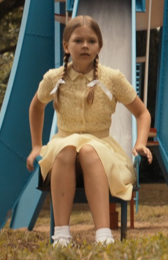
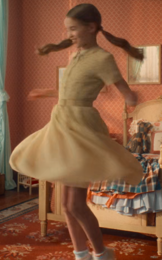
Spot the difference.
The only memories we are privy to that are new to this season, beyond the cave/mineshaft memories, are the briefest of brief scenes set in 1950s Hawkins High. They are as shallow as possible. We see a hallway and some brief rehearsal footage of the stage play that Henry was part of, and that is literally it. It’s impossible from these glimpses to understand what Henry’s emotional connection to these memories are. From The First Shadow, we know that high school was basically the only source of happiness in Henry’s childhood; It was where he met his first and only love, Patty Newby. But Patty Newby is conspicuously absent from the TV show. An in-universe argument can be made that all of his memories of Patty are being consciously suppressed by the Mind Flayer, who is keeping Henry miserable in order to control him. But if that’s the case, that’s still not satisfying because we never see that shoe drop. Unlike the mine-shaft scene, Henry never encounters any memories of Patty, and other characters that went to school with her never mention her either. People who haven't seen The First Shadow won't know about Patty at all. A cynical argument can be made that Patty is missing from the show because the Duffer Bros do not know, or care to know, about her, but they were contractually obligated to reference The First Shadow to help sell tickets. Or alternatively, they were contractually obligated to not mention her in order to help sell tickets.
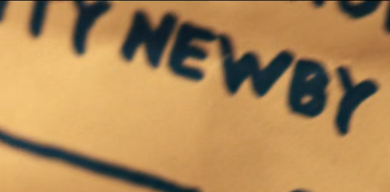
Patty's only reference in the TV show. Did you miss it?
All introspection is stripped from Henry in favour of making him a one-note, simple villain. Camazotz revolves around the Creel house because it’s a recognisable spooky house and it’s creepy to watch Holly eat at the same dining table that Henry murdered his family at. Alice’s dresses are a cute easter egg for the superfans. Any references to The First Shadow genuinely feel like advertising.
It all contributes to the feeling of wasting time. Emotionally, the audience cannot connect to any of the memories being shown because Henry isn’t emotionally connected to them. Even his fear of the cave feels less like an actual emotion experienced by a traumatised individual and more like a cheap way to keep the audience on the hook. When the audience initially sees young Henry get shot in the mine-shaft, almost no time is given to emotionally connect with the scene before it sets up yet another mystery box for the audience to stew over (the contents of the briefcase). And when Henry finally recovers his entire memory, he literally gives one last villain speech about how it basically doesn’t change his perspective on anything at all.
This final moment with Henry, where he decides to maintain his path of destruction, could absolutely still work in a universe where Henry is allowed more nuance. In fact, it could be all the more devastating. Looking at the sum total of Henry content, it tells the story of a child who is deeply traumatised, manipulated, and abused into becoming an abusive, unempathetic individual himself. He abuses others because it makes him feel in control of his own abuse. His mind is a prison of interconnected traumatic memories, not only his but also those he has tormented and killed, and that’s the only place he has to retreat to for safety. But most of this potential depth is shown off-screen and on-stage, or left in implication. For the people who haven’t seen The First Shadow, this last minute attempted redemption feels absurd. Whereas if you have seen The First Shadow, Henry’s lack of redemption arc and eventual decapitation as the main villain of the entire series feels completely tone deaf.
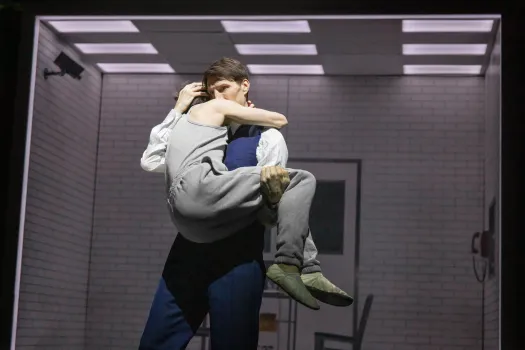
Justice for Henry Creel... Maybe.
Chapter Six: Stranger Danger
As a warning: the following chapter will contain discussions of sci-fi analogues for child sexual abuse.
Something that has been mostly sidestepped in this essay so far is the inherently uncomfortable energy of an adult man sweet talking children into coming home with him. That's because the show for its part is willfully ignorant of this subtext and seeks to soften it at any turn, at least past the point where Holly is kidnapped.
In the cold open of Stranger Things 5 we watch a flashback where Vecna restrains an unconscious little boy against a wall. A long tentacle emerges from off screen and slides deep down the young boy's throat. Vecna groans, his eyes roll to the back of his head, and thick clumps of unknown substance are shown being deposited through the tentacle into the boy's stomach. The scene is deeply uncomfortable and unsubtle. It is also tonally incongruous with the rest of the season.
The boy in this scene is Will Byers. In a scene which takes place in Season 1 but is set chronologically after this assault, he throws up some of the mystery substance into his bathroom sink. This ends up being a living tadpole creature that Will has essentially gestated and given birth to.
Later, in Season two, Will is attacked by an entity known as the Mind Flayer. This attack involves shadowy tentacles entering the boy's mouth. When he confides in his mother about this moment, he has dialogue that directly parallels sexual assault: “I felt it everywhere … I still feel it.”
The Mind Flayer does a similar action to hundreds of characters in Season 3. In the second instance, Vecna, in the form of a mind-flayed Billy, forcibly holds a woman against the floor and whispers in her ear, “Don’t be afraid. It’ll be over soon. Just be very still.” Again, it isn't subtle.
When Holly escapes from Camazots, she has a similar tentacle covering her mouth to the one that was inside of Will in Season 1. But for her, removing it is as simple as a light tug. She coughs a little bit, but there's no goop or tadpoles to be found. Instead, a CGI smoke cloud puffs out of her and she's right as rain. She never grapples with the psychological impact of whatever that was, but the audience also isn't encouraged to consider it too deeply either.
The same happens when the other kids have the tentacles removed from them in the finale; it is again as simple as popping them off their mouths. The day is saved, yippee! There is nothing dark or uncomfortable here. There is no lasting damage for these children.
Instead, the Camazots storyline depicts grooming in a mediocre PSA way. There’s creepy shots of Henry hanging around the school playground and classrooms. But none of it would feel out of place in a kids TV show. The only ulterior motives he has in getting close to Holly are clean sci-fi nonsense about collapsing wormholes and creating a nebulous evil perfect world. Any tentacles that are involved are just the mechanisms with which he has to do that. The allegories to sexual assault are merely a lingering byproduct of the production design of previous seasons, back when the show was capable of accessing darker topics. We don't have time for uncomfortable realities in Stranger Things 5. All we have time for is hype moments and aura. Derek telling Henry to “Suck his fat one” would be less entertaining if the show also had to grapple with Derek as a victim of sexual abuse.
It's not even that I think this overall tonal shift is wholly bad. The Season 5 cold open feels shockingly gratuitous and icky when coming fresh off of Season 4’s more action-oriented finale. But the undercurrent of Mr Whatsit as a pedophile is so undercurrent that it’s basically not present beyond his introduction, and that absence is felt.
The show also never delves into why a child might be drawn to Mr Whatsit in the first place, beyond the boring implication of mind control. Grooming is a long process involving subtle abuse tactics and groomers will often pick victims who will be susceptible to it. In theory, Holly is a very easy target. But the show doesn’t pick up on that.
There is a scene just prior to her kidnapping where Holly is upset by her parents arguing. They’re specifically arguing about how Ted doesn’t care enough about Holly, but the emphasis of the scene is not on the content of the fight. It just focuses on the fact that they’re fighting. In this moment of vulnerability, Holly turns to the D&D figure that Mike gave her. But given that this argument was about her dad’s lack of attention, wouldn’t it make more sense for her to try to turn to Mr Whatsit for comfort?
Likewise, both Thomas and Derek are dickhead little kids who like to feel important. It’s possible that there’s a deeper reason for this, or it’s just simply entitlement. Regardless, Mr Whatsit can give them that feeling of superiority.
Obviously giving every single kid a scene showing their specific baggage would be obnoxious, but showing it for Holly should be the bare minimum.
Camazotz blows a great opportunity to do this when Max and Holly run through Henry’s memories of Holly. The first one they encounter is a door leading into a dark basement. “It’s just memory,” Max says, “Whatever’s down there, it can’t hurt you.” But there’s nothing dangerous down there. It’s just a memory of Holly and Mary watching Nightmare on Elm Street 3: Dream Warriors. It’s only a scary memory because Holly was scared of the film at that moment. What if instead of wasting our time on an 80s pop-culture reference, we actually saw something truly upsetting for Holly?
Holly first meets Henry in the school library after school. But why was Holly alone in the school library after school in the first place? Was her dad supposed to pick her up and he forgot? Did she want to avoid going home because of her parents’ arguments? We don’t know! We don’t even know what conversations she has with Henry before he kidnaps her because they all happen off-screen.
(As a side note, this section of the show also never brings up that time that Holly was almost eaten by a demogorgon in Season 1. It’s not a crime that it misses that, but it’s a bit of a shame. Plus, I do think that’s actually the first time Holly and Henry met, if you want to be technical about it.)
When she’s brought to the house, Henry reveals that he knows her favourite food is blackberries, and she’s confused as to how he knows this. What have they even been talking about this whole time? Are they even friends? We only see them speak twice before Henry kidnaps her. If that is the sum total of their verbal interactions, it is a shockingly short time to win anybody’s trust, even the most sheltered ten year old.
Again, this is all the path of least discomfort, which is absolutely ridiculous for a horror show.
Chapter Seven: Why Even Bother?
Camazotz is a bad idea on its face. So why did they bother doing it? They could have done literally anything else. There’s a number of possible reasons that Camazotz was made that have already been alluded to: They wanted to create parallels to Season 1, they wanted to bring in a younger generation of audiences, and they wanted a plot point that would appeal specifically to girls. But there’s one other reason that must be considered: Vecna sucks.
The Duffer Bros fucked up royally with Vecna. That is to say, the big red worm boy just isn’t a compelling villain. I’m sure there are Vecna fans. Somebody must be buying the Funko Pops. But Vecna is so boring. He’s like if you stuck Pennywise and Freddy Krueger into a blender, and then poured half the resulting mixture down the drain. And then you stuck a clock in the remaining goop. I know some people find Season 4 to be scary, but the Vecna horror doesn’t work for me. Most of his scenes involve generic CGI spooky faces saying mean things. And the way that he kills people (by breaking all of their bones and then popping out their eyes) is so over-the-top and the special effects are so unconvincing that it becomes silly. It has the same energy as a 12 year old’s first creepypasta OC.
I don’t want to roast him too much, but he looks awful too. The show never successfully makes him look scary. He’s just gross and not in an interesting way. His redesign in Season 5 is higher budget, but it’s mostly a lateral move from an already mediocre design. His face has too much prosthetics that it makes it hard for Jamie Campbell Bower to emote or annunciate. And then they modulate his voice to fuck so you extra can’t tell what he’s saying. Even when you do lock into his dialogue, it’s all just generic supervillain speeches.
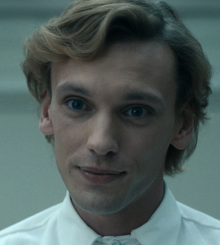
But do you know who is a compelling villain? Henry Creel. Specifically, Henry as One in Eleven’s flashbacks in Season 4. He’s a charming, manipulative character. He is somehow simultaneously calming and unsettling. And he manages to be so engaging because he is, on the surface at-least, a friendly human. In a series where the other main supernatural villain is an eldritch spider kaiju, it’s good to have balance in the form of a more human villain. And the show knows this! Season 1 has Papa as a secondary villain, and he’s great. Season 2 and 3 have Billy, with Season 3 also adding a couple of zombies. For the record, Mind-flayed!Billy in the sauna scene of Season 3 is more tense and scary than anything Vecna does in Season 5. Henry being introduced as a new mainstay human villain to the franchise, and a character foil for Eleven, is conceptually perfect. Unfortunately, he isn’t really human anymore chronologically. He’s a lobster Skeletor.
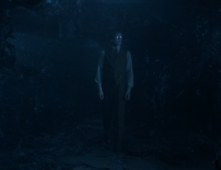
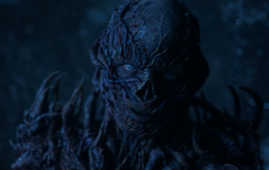
Sometimes less is more.
Mr Whatsit feels like an attempt to recapture some of the magic of One, seemingly done with the knowledge that Vecna just isn’t a good enough villain on his own. Without Mr Whatsit, the only other distinctly human villain of the season is Dr Kay and that one soldier who works for her. Who cares about them? Dr Kay doesn’t even have a backstory. She’s just doing her job and she isn’t even good at it.
But unfortunately, the deficits of Camazotz make this a fool’s errand. Mr Whatsit is quite fun! I enjoy his scenes! I support the agenda for more Henry Creel screentime. My enjoyment of Henry Creel is partially why I’m writing this. More specifically, I enjoy Jamie Cambpell Bower’s performance. He evidently cares a lot about Henry, as he has shown in interviews and behind-the-scenes footage, and it shows in his acting. But the show doesn’t care as much as he does. It’s all in service of an incredibly shallow character. But if they simply wanted a shallow villain, Vecna isn’t fun enough for that to be sustainable. Season 4 had four storylines and Wormy!Vecna was only present in one of them.
There is one moment of Season 5 that could serve as a blueprint for a Vecna-centric season. I’ve already mentioned that I find the scenes of Vecna using his powers to be unimpressive from a horror perspective. There is one exception to that and it ironically comes from the finale of all episodes. Hopper, reacting to taunting hallucinations from Vecna, is led to believe that he has accidentally shot and killed Eleven. It’s maybe the most effective scene of Vecna using his powers in the entire show. We get a glimpse into Hopper’s fears, it disrupts the hero’s plans in an unexpected way, and it’s visually upsetting. It’s reasonable to assume that the entire final season would be full of moments like this.
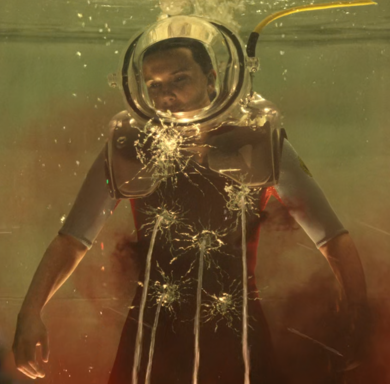
Where was this energy during the rest of the season?
But it’s not. And in place of that, or anything else worthwhile, the season chooses to focus on (and say) nothing.
Chapter Eight: Can We Fix It?
No 👏 We 👏 Can’t!
In a perfect world, Camazotz would have been a spin-off series. Unfortunately, that would also come with its own problems, as seen with The First Shadow. Fans were reasonably upset that they would have to seek out expensive supplemental material to understand Season 5 fully. Ironically, this was not true because Season 5 avoids The First Shadow like the plague, and watching it actively makes Season 5 worse. But even if Stranger Things: Camazotz was dropped on Netflix as a miniseries or movie, some of the audience would probably resent having to watch a spin-off to understand the main show. Especially a spin-off that is not tonally or narratively similar to Stranger Things at all.
So you could just get rid of it, and instead focus entirely on the set-up from the end of Season 4. Except that runs into the problem of Vecna not being an entertaining enough villain for an entire season of television.
I like Camazotz, conceptually. I think it always would have felt out of place, but I think it didn’t need to be this pointless. It’s ultimately just a huge shame.
TL;DR: Feel like pure shit, just want her back x